Petra Vogel · 29 October 2026
Enolyra's Hierarchical Tagging Systems and Their Role in Federated Search Across Distributed Knowledge Repositories
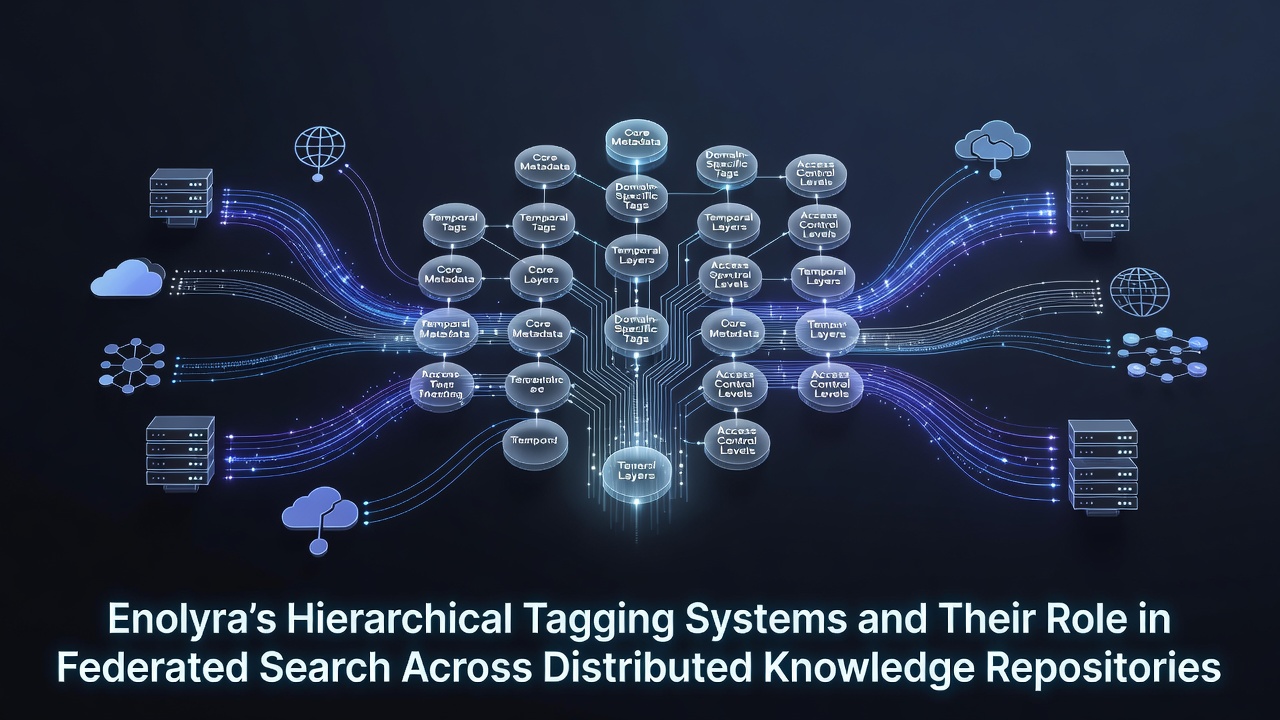
Enolyra's hierarchical tagging systems organize content through multi-level structures that assign tags in parent-child relationships across nodes, which allows queries to traverse distributed repositories without requiring central data consolidation. These systems build on established metadata frameworks yet extend them with dynamic inheritance rules that propagate tag attributes downward while permitting local overrides at individual repositories. Observers note that this approach supports consistent categorization even when repositories operate under separate governance models or storage protocols.
Core Mechanics of Hierarchical Tagging in Enolyra
Each tag in the Enolyra framework sits within a defined tree where broader categories such as "research outputs" contain narrower descriptors like "clinical trial results" or "longitudinal survey data," and the system records these relationships in a lightweight index that federated search agents consult during query routing. When a search request arrives, the engine evaluates the hierarchy to expand or narrow results automatically, pulling matches from repositories that may store only fragments of the full knowledge graph. Data from October 2026 indicates that several institutional deployments reported measurable reductions in query latency after implementing these inheritance rules, particularly in environments spanning academic, governmental, and corporate collections.
Repositories maintain local tag mappings that align with the global hierarchy through periodic synchronization protocols, while conflict resolution occurs via priority weighting assigned during initial setup rather than real-time negotiation. This design keeps individual sites autonomous yet ensures that searches conducted across the federation return coherent result sets ordered by relevance signals derived from tag depth and usage frequency.
Federated Search Integration Patterns
Federated search agents in Enolyra leverage the hierarchical structure to route sub-queries intelligently, directing broad category searches toward repositories known to hold high volumes of parent-level content and refining subsequent calls with child tags for precision. The process relies on pre-computed tag affinity scores that reflect historical query patterns, allowing the system to anticipate which nodes are likely to hold relevant material without exhaustive broadcasting. Researchers have documented cases where this method improved recall rates in multi-institutional health data networks by surfacing records that simpler keyword matching overlooked.
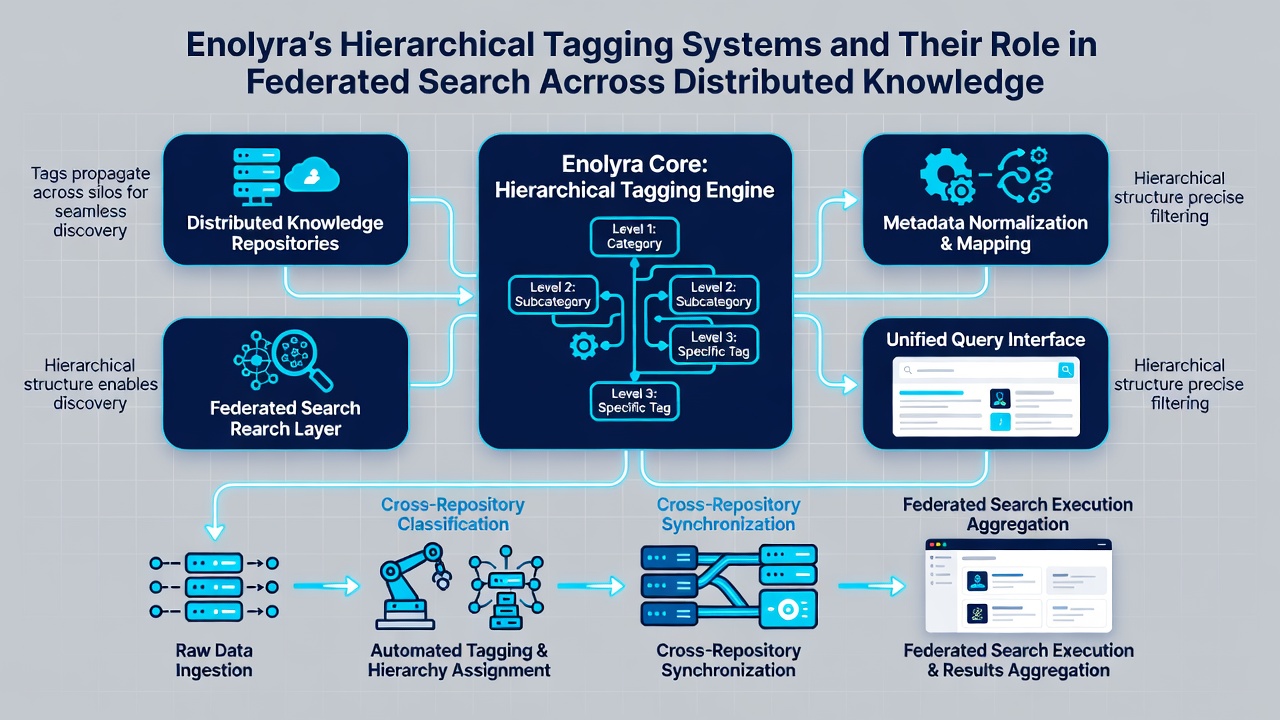
October 2026 updates introduced enhanced support for cross-repository tag alignment through standardized schema extensions, enabling smoother integration with external indexing services while preserving the core hierarchical logic. These enhancements addressed previous limitations in handling multilingual tag variants, allowing the system to treat translated child tags as equivalent under a shared parent without duplicating index entries.
Handling Distributed Repository Challenges
Distributed knowledge repositories often differ in update frequency, access controls, and underlying storage formats, yet Enolyra's tagging layer abstracts these differences by maintaining a unified view of tag relationships that search components consult independently of physical location. When a repository undergoes schema migration, the hierarchical mappings remain intact because they reside in a separate metadata overlay rather than embedded within each record. Studies from institutions using similar layered approaches show that this separation reduces the risk of search index corruption during platform transitions.
Security considerations receive attention through tag-level access rules that inherit permissions from parent categories while allowing fine-grained exceptions at lower levels, which supports compliance requirements across jurisdictions without forcing uniform policies on every participating repository. The system logs tag traversal paths during searches, providing audit trails that administrators review to verify that queries respect established boundaries.
Observed Outcomes in Operational Settings
Organizations deploying Enolyra have recorded improvements in result relevance when hierarchical tags guide result ranking alongside traditional term frequency metrics. In one documented deployment spanning North American and European research networks, the addition of depth-weighted scoring increased the proportion of highly cited documents appearing in top result positions. Figures from the US data management initiatives align with these patterns, indicating that structured metadata hierarchies contribute to more reliable cross-collection discovery.
Another implementation at an Australian university consortium demonstrated that hierarchical tagging reduced duplicate result surfacing by identifying overlapping content through shared child tags even when source repositories used different record identifiers. The approach proved particularly useful during periods of rapid content growth, when new repositories joined the federation and needed immediate integration without extensive manual mapping.
Conclusion
Enolyra's hierarchical tagging systems provide a structured method for managing metadata relationships that directly supports federated search operations across distributed knowledge repositories. By maintaining parent-child tag connections in a separate overlay and using them for query routing and ranking, the framework accommodates differences in repository governance and technology stacks while delivering consistent search behavior. Developments noted through October 2026 reflect ongoing refinements in synchronization and multilingual handling, yet the fundamental architecture continues to emphasize autonomy at each node alongside federation-wide coherence. Additional sources such as reports from European open data efforts further illustrate how layered tagging contributes to scalable discovery in heterogeneous environments.